
BREAKING NEWS
Hanoi, March 19, 2013 – Education for Nature-Vietnam (ENV) is concerned that a new circular being
drafted by the Ministry of Agriculture and Rural Development (MARD) could perpetuate bear farming and
undo years of progress towards phasing it out completely.
The circular is aimed at reinforcing government efforts to manage captive bears and phase out bear
farming in Vietnam, and will replace Decision 95 of August 2008. Although the draft includes many
improvements that should benefit efforts to control the number of bears on farms, two clauses – that
permit bear farmers to breed bears and raise cubs born on their farms – are viewed by experts as
loopholes that will result in more, not less, bears on farms.
MARD is holding a special consultative workshop on March 22, 2013 to review comments on the draft
circular, and a decision on its adoption is expected to be made shortly thereafter. ENV will attend the
workshop to raise its concerns in the hope of preventing a reversal of current successful efforts to phase
out bear farming in Vietnam.
“If bear farmers are allowed to register and keep captive-born cubs on their farms, this will not end bear
farming in Vietnam, but will prolong this illegal business indefinitely”, says Mr. Tran Viet Hung, Vice
Director of ENV. “Allowing owners to keep cubs at farms and zoos which commercially exploit bears is in
direct conflict with the commitments of MARD to end bear farming, and also undermines the success that
MARD has achieved to date in reducing the number of captive bears.”
In 2005, MARD initiated a nationwide campaign requiring all bear farm owners to register their bears. A
microchip was inserted into each captive bear as a unique form of identification and to prevent bear farm
owners from bringing new unregistered (un-chipped) bears onto their farms. The ambitious and costly
scheme was to result in a “natural attrition” of bears on farms, as older bears died and were not replaced.
Evidence suggests that this campaign, coinciding with a strong commitment by MARD to phase out and
permanently end bear farming in Vietnam, has been working successfully, with numbers dropping steadily
since 2005 from 4,500 to an estimated 2,300 bears remaining on farms today.
“This reduction in the number of captive bears on farms is a remarkable indicator of the success of the
program”, says Mr. Hung. “Vietnam has shown the world that we are putting an end to this cruel and
illegal business, and making progress in fulfilling our global responsibility for the protection of bears, not
just here in Vietnam, but also in other countries where many of the bears on our farms originated.”
ENV acknowledges that MARD has done an outstanding job thus far in fulfilling its commitment to phase
out bear farming; however, if the new circular is signed in its current form, ENV warns that Vietnam will
take a step backwards in its responsibility for the protection of bears in Vietnam. “Now is not the time to
undermine this excellent progress, but to continue moving forward confidently and resolutely toward the
ultimate goal of phasing out bear farming,” says Mr. Hung.
LINK TO CURRENT DECISION IN ENGLISH
READ MORE ABOUT THE CIRCULAR AND it’s IMPACT
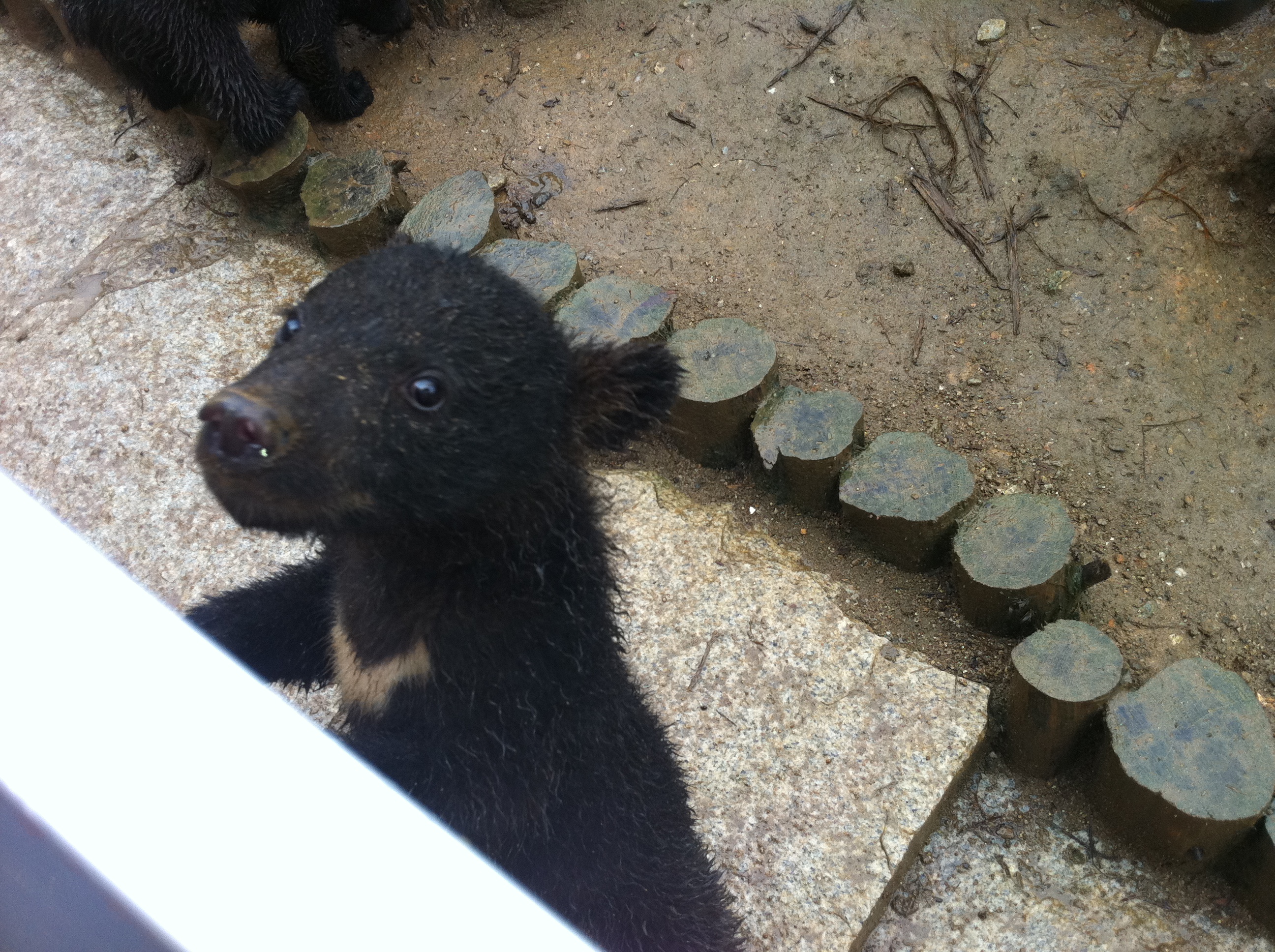
Cub exhibiting begging behavior in commercial facility
COMMENTARY
In September of last year, the International Union for Conservation of Nature (IUCN) World Congress passed a resolution calling for the phase out of bear farming in 4 of the 5 ‘bear farming countries’; specifically naming Korea and Vietnam. As the IUCN is the world’s oldest and largest global environmental organisation, resolutions passed by the IUCN are highly influential in determining the direction of world conservation methodology. For the eradication of bear bile farming, this is a giant step in the right direction.
Earlier in 2012, we witnessed both verbal and financial commitments from the Korean government that led us to believe that we can expect an end to the trade in the near future. In early 2012, the Korean government allocated funds (about US$175,000) to conduct research on the farm bear situation, and presumably, to identify an efficient exit strategy from the trade. Unfortunately, we are not aware of any practical application or publicly reported findings from this RnD. We don’t feel that the phasing out of bear bile farming is appropriately prioritised by the government at this time. We have welcomed a new administration, and hope to see progress on this issue soon.
A next logical step in Korea would be a ban on breeding. Animal advocates have disagreements regarding the “next step after that”, but we all would wish for no new bears to be be born into a life of suffering on Korean bear farms.
We are concerned that if bear bile farming is outlawed in Korea, we may see an increase in black market tourism and trade. Vietnam has been the target of such tourism in the past, as has China.
 SAVING BEARS...